Blogs

Too Much Screen Time? Science-Backed Ways to Reset Your Child’s Habits (Without Tears or Fights)

Too Much Screen Time? Science-Backed Ways to Reset Your Child’s Habits (Without Tears or Fights)

It’s 4 pm. Ananya has been watching TV since she came back from school. I remind her to turn it off. She promises me “5 more minutes.” Hours later, I peek through the home camera—she’s still glued to the screen. My temper shoots, I scold, and moments later I get a message: “Mumma, I hate you!”

If you’ve ever been called the ‘meanest parent ever’ just for switching off the TV, you’re not alone.

For many parents, screen time has become a daily battlefield. But here’s the truth: it’s not just your child being “stubborn.” It’s biology, design, and context at play. Let’s unpack this—and learn practical, science-backed ways to reset screen time habits without tears and tantrums.


Why Do Kids Crave Screen Time?

Screens are designed to be addictive. Bright colors, auto-play, and endless feeds create dopamine surges in the brain—the same system that makes adults binge-watch Netflix until midnight.

For kids, it’s harder:

  • Developing brains: Their impulse control isn’t fully wired yet.
  • Boredom triggers: Older kids turn to social media when bored or under peer pressure.
  • Parent habits: Many of us introduced screens early—feeding toddlers while playing cartoons or using them as a “babysitter.”

Traditional joint family structures provided natural entertainment and engagement through stories, games, and multi-generational interactions. Today’s nuclear families, especially in urban areas, often rely on screens to fill this engagement gap.

Busy working parents amplify this challenge. Sometimes we choose screens when we’re tired or unsure how to engage meaningfully.

Many of us, myself included, have relied on screens as a quick fix for fussy meals or tired evenings. The key is not guilt—but small, intentional resets.


What Counts as “Too Much”?

According to the American Academy of Paediatrics (AAP):

  • Under 18 months: No screen time (except video calls).
  • 18–24 months: Only high-quality media, with parent guidance.
  • Ages 2–5: Max 1 hour/day, co-viewed.
  • Ages 6+: Max 2 hours/day (excluding homework).

This can be a guide to screen time rules for kids in India.


The Hidden Costs of Excessive Screen Time

Research and studies by NIH establish:

  • Exposure to more than four hours/day of screen time was associated with higher symptoms of depression, anxiety, and stress.
  • Children spending >2 hrs/day score lower on language and thinking tests.
  • Children spending >7 hrs/day show thinning of brain cortex.

Some long-term consequences of excessive screen time include:

  • Sleep problems: Difficulty falling asleep or getting restful sleep.
  • Mood swings: Increased irritability or anxiety.
  • Social withdrawal:Spending less time with family and friends.
  • Loss of interest: Neglecting hobbies or activities previously enjoyed.
  • Physical complaints: Frequent headaches, eye strain, or neck and shoulder pain.
  • Reduced attention span: Difficulty concentrating on tasks.

Feeling overwhelmed? You don’t have to fix this alone. 👉 Jump to the end and get the Screen Time Reset Kit


Resetting Screen Habits: Science-Backed Strategies

We will explore some science-backed parenting hacks for screen addiction, and reduce kids screen time without fights.

Here are doable shifts that actually work:

Set clear daily limits – Keep them consistent. Kids thrive on routine.
Give choice within boundaries – Let them pick content/time slot.
Start small – Reduce by 15 mins each week instead of a sudden ban.
Offer healthy swaps – Outdoor play, hobbies, family projects.
Co-play & co-watch – Be fully present. Put your phone away.
Celebrate wins – Track progress, reward milestones.
Define no-screen zones – Mealtime, bedtime, mornings.
Model habits yourself – If you scroll all evening, kids will too.


Practical Implementation Guide

  1. Assessment: Before changing behavior, we need baseline data. Assess current usage: Note patterns, content, peak times.
    • Track Current Usage: Use built-in screen time reports (iOS Screen Time, Android Digital Wellbeing) to measure actual usage vs. perceived usage
    • Review Content: Document what your child watches/plays during peak usage times
    • Identify Trigger: Note emotional states that trigger screen requests (boredom, frustration, transitions). I realized my daughter’s screen time peaked when I was working from home and on days with no classes, and this helped in planning her screen time and other activities.
  2. Create a screen plan together:
    • Let kids co-design rules & schedules.
    • Help them prioritize urgent and important tasks like homework, exam preparation, project submission, outdoor play.
    • Decorate the Screen Plan and place it strategically for visual reminder.
  3. Use smart swaps:
    • Substitute mindless online content with age-appropriate educational programs (like “Sesame Street”, “PBS Kids”, Art for Kids Hub, TED-Ed shows can teach children facts, healthy behaviours, and emotion management when used strategically).
    • Replace binge TV with enriching shows, reading, or creative activities.
    • Visible Alternatives: Art supplies, books, puzzles in easily accessible locations
  4. Introduce transition rituals: Instead of abrupt cutoffs, use transition warnings that help children emotionally prepare. e.g., 10-min music dance party before shutting off the screen.
  5. Set up screen-free zones and Zero-Tolerance No Screen Policy
    • Set up screen-free zones – Dining table, Bedroom, Study Spaces.
    • Zero-Tolerance No Screen Policy
      • Meal/Play Times: No Background TV during meals/play
      • Mindful Watching: No YouTube scrolling without specific purpose
      • Bedtime Routine: No Screens within 1 hour of bedtime
      • Morning Routines: No screens until after breakfast and getting dressed
  6. The “Boredom Buster” Jar: Screens are the quick fix when a child is bored. To break the habit, you need an accessible alternative. Create a jar filled with “chits” featuring your child’s favorite offline activities (craft kits, board games, instrument play). The next time they look for a screen to fill the void, have them pull a chit instead. It removes the struggle of “finding something to do” and makes unplugging feel like a game of chance.
  7. Weekly joint project: Identify one activity that your family loves and look forwards to during the weekend. It can be anything from Family cooking, crafts, gardening—something that vibes with your family. Prepare in advance.

Implementation of this strategy when coupled with emotional regulation can lead to high impact solutions. You can check this post on understanding and managing emotional meltdowns to get you started on supporting your kid to develop emotional regulation.
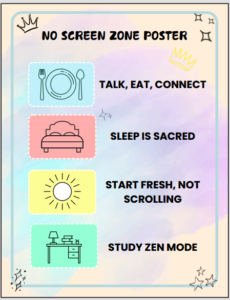
No screen zone poster for kids
Download this “No Screen Zone Poster” for kids

Print this poster and stick it on the dining table today.


Conversation Starters with Kids

Instead of commands (“Switch it off now!”), try questions:

  • “What’s one fun thing we can do together instead?”
  • “How does your body feel after too much screen time?”
  • “Want to plan a no-screen challenge this weekend?”

Pro Tip: Use Tools Wisely

Parental controls are great—but don’t rely on them alone. Quality matters as much as quantity. Shift from endless passive watching to active, meaningful digital experiences.


Final Word: Big Change Starts Small

Resetting screen time isn’t about punishment—it’s about building self-control and healthy alternatives. When kids feel empowered, and parents model balance, screen habits reset naturally.

📩 Want a Printable Screen Time Reset Kit?

Get our free, research-backed toolkit with:

  • A Weekly Media Planner (co-create with your child!)
  • No-Screen Zone Posters for your home
  • A fun Reward Tracker to celebrate milestones

After two weeks of using our screen plan, Ananya now shuts down the TV herself at 6:30 pm because she’s excited about our family game.


🔑 Key Takeaway for Parents

Screens aren’t the enemy—uncontrolled use is. With clear boundaries, engaging alternatives, and family consistency, you can raise a screen-smart child without daily battles.

Know another parent fighting the screen-time battle? Share this post with them.

Written by Anshula Verma

Why Smart Kids Struggle with Decision-Making (and 4 Science-Backed Strategies Parents Can Use Today)

Why Smart Kids Struggle with Decision-Making (and 4 Science-Backed Strategies Parents Can Use Today)

Why Smart Kids Struggle with Decision-Making

Have you experienced the distressing moment when your bright 8-year-old breaks down choosing between chocolate and vanilla ice cream.

It feels baffling, right? Here’s a child who solves math problems in minutes, recites poetry like a pro, or explains science concepts better than most adults — yet when faced with everyday choices, they melt down, get stuck, or make hasty decisions they end up regretting.

If this sounds familiar, you’re not alone. In today’s fast-changing world, India is raising some of the brightest academic achievers — but many lack one of the most critical life skills: making wise decisions.


The Neuroscience of Decision-Making: Why Smart Kids Struggle

This is something most parents don’t realize: intelligence and decision-making ability aren’t the same.

Neuroscience studies uncover an interesting fact about the development of children. The prefrontal cortex, the part of the brain that is in charge of decision-making, planning, and controlling impulses, keeps on developing until about age 25. Children and adolescents, meanwhile, rely more on the limbic system (emotions) to make decisions, which explains why “gut feelings” often win over rational thought.

Scientific Insight: Neuroscientist Dr. Sarah-Jayne Blakemore’s work shows how the slow development of the prefrontal cortex makes young brains less equipped for complex choices (NeuroImage, 2012).

Think of it this way: your child’s brain is similar to a high-performance sports car with an underdeveloped navigation system. The engine (intelligence) is strong, but the navigation system (decision-making) isn’t fully built yet.

Don’t have time for the science? 👉 Jump to the 4-Step Decision Making Framework for Kids


Why This Matters More Than Ever for Indian Families

In many Indian homes (mine included while growing up), parents made most decisions — from food to studies to careers. While that approach worked in a predictable world, today’s kids need to be independent thinkers and problem-solvers.

I know this first-hand. I was the “topper” at school, showered with praise for excellent grades. My family’s well-intentioned guidance – “Beta, we’ll decide what’s best” – had never prepared me for independent thinking. I wasn’t given choices, and I struggled with decision-making later in life. That’s why I want my child — and yours — to have a head start.

👉 The challenge: How do we honour our cultural strengths while raising children who can confidently make choices in an unpredictable future?


The Science Behind Smart Kids’ Decision-Making Struggles

  • The Development Gap: Since the prefrontal cortex is still under development, pre-teens and teens may more likely use a region of the brain known as the amygdala (emotional center) to make decisions and solve problems than adults. This implies even smart children tend to make decisions based on feelings, not reason.
  • The Intelligence Paradox: Smart children often face unique decision-making challenges:
    • Analysis Paralysis: High intelligence can lead to overthinking, where children see too many options and possibilities, making it hard to choose.
    • Perfectionism Trap: A fear of making the “wrong” choice can paralyze decision-making, as smart kids are used to getting things right.
    • External Validation Dependency: Since kids are always rewarded for “correct answers,” they become hesitant to make a decision independently without validation or approval.
  • Cultural Factors: Decision-making in Indian families is usually a group activity that includes several family members, highlighting interdependence and cooperation. Although this creates strong family ties, sometimes it restricts opportunities for children to develop independent decision-making confidence.

Evidence-Based Strategies to Strengthen Your Child’s Decision-Making Skills

As a learning platform for life skills for kids, we believe that empowering parents is the first step. Here are proven strategies to help your child become a confident decision-maker.

  1. Start Small, Think Big (Ages 5-8): The Foundation Years Strategy

Begin with low-stakes choices that match your child’s developmental stage. Offer two options and give them time to decide. Praise them when they make the choice, especially if they do it quickly. This builds confidence early.

  • Practical Examples:
    • Daily Choices: “Would you like aloo paratha or poha for breakfast?” “Would you like to wear the red shirt or blue shirt today?”
    • Weekend Planning: “Should we visit Nani or go to the park this Sunday?”
    • Study Schedule: “Do you want to do math homework before or after your TV time?”

👉 Pro Tip: Frame choices around family values. “Both are healthy options. Which feels right today?”

Research shows that consistent decision-making practice strengthens specific prefrontal cortex pathways in children.


  1. Teach the Decision-Making Process / Framework (Ages 7-10): The Four-Step Method

Research shows that modelling decision-making with general questions can help your child process information effectively. Use this four-step method:

  • 🛑Step 1: Identify the problem: “What decision do you need to make?”
  • 🔍Step 2: Gather information: “What do you know about each option?”
  • ⚖️Step 3: Consider consequences: “What might happen if you choose this?”
  • ✅Step 4: Make the choice: “Which option feels best based on what you’ve learned?”

This reduces overwhelm and builds structured thinking.


  1. Nurture Emotional Intelligence (Ages 8-12)

Teaching children to be aware of their emotions and how these feelings can influence their choices is a vital step.

  • Strategies: Help children name their emotions before they decide. Teach them coping mechanisms like deep breathing or talking about their feelings to reduce emotional intensity (read our guide on managing meltdowns here, leading to clearer thinking.

  1. Create Safe Spaces for “Wrong” Decisions

Children often learn best from their mistakes. Letting them make age-appropriate mistakes is crucial.

  • Examples:
    • Allow them to choose an outfit that might get them teased (as long as it’s weather-appropriate).
    • Allow them to spend their pocket money on a short-lived toy (something they might regret).
    • Let them pick a book that might be too easy or too hard

👉 Follow up with a “learning conversation”: “How did that feel? What would you try next time?”


The Indian Parent’s Advantage

Indian families already have strong cultural tools that can be leveraged in developing a child’s decision-making skills:

  • Joint Family Wisdom: The joint family system provides multiple perspectives and collective decision-making models.
  • Value-Based Upbringing: Our culture provides clear ethical guidelines for decision-making.
  • Storytelling Tradition: Our folk tales and epics naturally explore choices and consequences.

Raising Future-Ready Kids

The goal isn’t perfection — it’s confidence. Kids who practice decision-making learn to think critically, take responsibility, and grow stronger with each choice.

🌱 With the right mix of neuroscience insights, tools and India’s cultural strengths, you can raise not just smart kids — but wise, resilient, future-ready leaders.

The children who learn to make thoughtful choices today will become the leaders, innovators, and problem-solvers our world desperately needs tomorrow.


Is your child “Book Smart” but “Decision Stuck”?

Download our Critical Thinking Cheat Sheet to give them the right questions to ask themselves.

Want more parenting insights? Subscribe to our newsletter for weekly science-backed strategies delivered straight to your inbox.

Ready to start building your child’s life skills? Our comprehensive program combines cutting-edge child development research with culturally relevant practices designed specifically for Indian families.

https://growupwise.com

Related Reading: Why Kids Have Meltdowns: The Surprising Science Behind Tantrums (and 3 Steps That Work)

Written by Anshula Verma

How One Mom Turned Exam Stress into an Adventure (No Tears Involved)

How One Mom Turned Exam Stress into an Adventure (No Tears Involved)

I’ll never forget the day my 8-year-old daughter almost broke down before her first Olympiad exam.
She had been studying well, but that evening, panic set in. Her eyes welled up, her voice trembled, and she insisted on staying up till midnight to “cover everything.”

As a mom, I had two choices:
👉 Fuel her stress by piling on more revision
👉 Or support her emotional wellbeing and shift her perspective

I chose the second.

I told her:

  1. “Don’t stress. This exam is just practice – I want you to experience it, not fear it. Do your best, that’s enough.”
  2. “Let’s do a quick revision together, and then we sleep.”

And guess what? She did more than fine. But the bigger win? She walked into that exam calm, supported, and smiling.


Why Kids Feel Exam Stress (Even Without Pressure from Parents)

Here’s the surprising truth:

  • Kids in India grow up in a culture where excellence in exams is a synonym of success. We have been conditioned in a way to look at exams as the ultimate test of our knowledge and worth.
  • Even when parents don’t pressurize, kids internalize this message from peers, teachers, and society.
  • Stress builds up, making exams feel like “do-or-die” rather than just one step in learning.

Stress may lead to physical as well as psychological issues. Science shows that stress narrows focus, reduces recall, and affects performance. But when kids feel safe and see exams as a challenge rather than a threat, their brains switch into a higher-performance mode.

Already dreading the next exam? 👉 Jump to the end and get the printable Treasure Map Exam Kit


Reframe Exams as an Adventure 🚀

Instead of a “test of worth,” what if exams were seen as a treasure hunt? Imagine if exams were positioned as an adventure or challenge to the kids!

Here’s how I did it – and how you can too.

The Treasure Map Technique

Printable Exam Treasure Map for Kids
This is the exact map I used. Download the blank template.
  1. Design the Map Together
    • Draw a simple treasure map with milestones (like checkpoints).
    • Let your child decorate it – turning it into a fun family activity.
  2. Set Milestones
    • Daily self-study (1 hr)
    • Practice with a friend (a week before the exam)
    • Mock exam at home (with you as the teacher!)
    • Final exam
    • Results → Treasure!
  3. Build in Rewards
    • Small “micro rewards” for each milestone (extra playtime, a favourite snack).
    • A grand treasure after the final exam (family outing, playdate, new game).
  4. Visible Reminder
    • Hang the Treasure Map where your child sees it daily (study desk, bedroom).
  5. Evening Check-ins (Daily)
    • Keep track of progress together.
    • Celebrate small wins, talk through setbacks, and keep it light.

Remember: Praise and reward the effort. The results will build up with consistency.


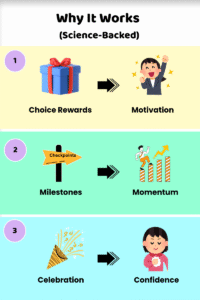
Why It Works (Science-Backed Insights)

Why it works
Why it works

Choice Rewards boost motivation – kids are more likely to stay committed when the reward feels personal.
Clear Milestones break the “scary big exam” into small, doable steps.
Celebrating Progress (which builds a Growth Mindset) keeps confidence high and stress low.

This simple reframe – from exam stressexam adventure – helps kids perform better and stay emotionally strong.


Try This at Home

Turn Stress into a Game. 

👉 Want a ready-made, printable Treasure Map Exam Adventure Kit?
I’ve designed a fun, parent-child toolkit you can download free – with templates, reward ideas, and tracking sheets.

Let’s make exams about growth, not tears. 💙


Over to You

Tried this map? I’d love to see it! Reply to my welcome email with a photo of your child’s map, and I might feature it on our Instagram!

Written by Anshula Verma

Why Kids Have Meltdowns: The Surprising Science Behind Tantrums (and 3 Steps That Work)

Why Kids Have Meltdowns: The Surprising Science Behind Tantrums (and 3 Steps That Work)

It happened a few years ago, but I still remember it vividly.
It was my birthday, and I had taken a day off work to celebrate. My 7-year-old and I headed to the mall for a fun day. But within minutes, my “perfect” birthday was derailed — by a full-blown meltdown in the middle of a toy store.

My child wanted a new doll. I said no.
What followed was crying, refusal to move, and a dramatic floor-sit. I felt angry, embarrassed, even helpless.

If this sounds familiar, you’re not alone. Whether your child is 5 or 12, meltdowns, tantrums, and sudden bursts of anger are surprisingly common — even in calm, “well-behaved” kids.

Here’s the truth: these outbursts aren’t about defiance. They’re about the brain.

👉 Before we dive in, grab my free Calm-Down Toolkit — a parent-friendly PDF with quick techniques you can print, try, and share to turn meltdown moments into calmer ones. It’s the same set of tools I wish I had that day.

When your child loses it, it’s not about bad behavior. It’s about biology.


The Science: Why Kids Lose Control

  • Kids are not “mini adults.”
  • The emotional center of the brain (amygdala) develops much faster than the thinking center (prefrontal cortex).
  • During an emotional trigger, the amygdala floods the brain with stress hormones — hijacking logic in less than a second, almost instantly.
  • This is why your child can’t just “snap out of it.” Their brain literally can’t process reasoning until they calm down.

And here’s the kicker: our anger adds fuel to their fire.


Inside Your Child’s Head During a Tantrum

Imagine what might be racing through a child’s mind when you say “no” to a toy, screen time, or playdate:

  • “All my friends have it — why not me?”
  • “Mumma never listens.”
  • “This isn’t fair!”
  • “I feel hurt and helpless.”

They’re not plotting to ruin your day. Their brain is simply overwhelmed by emotions it can’t yet manage.


The 3-Step Calm Process

Here’s a simple routine that works across ages 5–12:

🗣️Step 1: Name the Feeling
Say calmly: “I see you’re upset/angry/disappointed.”
Validation opens the door to calming down.


🛑Step 2: Pause Together

  • Take 3 deep breaths.
  • Count backwards slowly from 10.
  • Try “balloon breathing” (hands on belly, pretend to inflate a balloon).

Even 30 seconds of pause can flip the brain from “fight” mode to “think” mode.


🤝Step 3: Offer a Small Choice

Give two positive options: “Would you like to read your favourite book or get some frozen yogurt?”
This restores a sense of control without caving in.


👉 These are just the basics. In the Calm-Down Toolkit you’ll find printable tools, fun exercises, and kid-friendly scripts to make this easier at home.


Why It Matters

Each time your child practices calming down, their brain builds stronger neural pathways for self-control. Over time, emotional regulation becomes a lifelong skill — one that predicts success more strongly than IQ.


FAQs: Parents Ask, Science Answers

Q: Does this mean I should always give in?
No. The goal isn’t to buy the toy or extend screen time. It’s to teach calm before reasoning. Boundaries stay firm.

Q: What if my child is older (10–12) and “should know better”?
Even tweens’ brains are still under construction. Their amygdala is fast; their prefrontal cortex is still catching up.


Your Takeaway

Next time your child is on the verge of a meltdown, remember:

  • They’re not doing it to you.
  • Their brain is still learning.
  • With the right tools, you can guide them back to calm.

💡 Start with the free Calm-Down Toolkit and try one technique this week. Small steps create big shifts over time.


👩‍👧 In my own journey, using these science-backed tools transformed how I parent. My daughter — once quick to tears and tantrums — is growing into a more emotionally grounded, resilient preteen. It’s possible for your family too.

✨ Stay tuned for my next post: “How One Mom Turned Exam Stress into an Adventure (No Tears Involved).”

Written by Anshula Verma