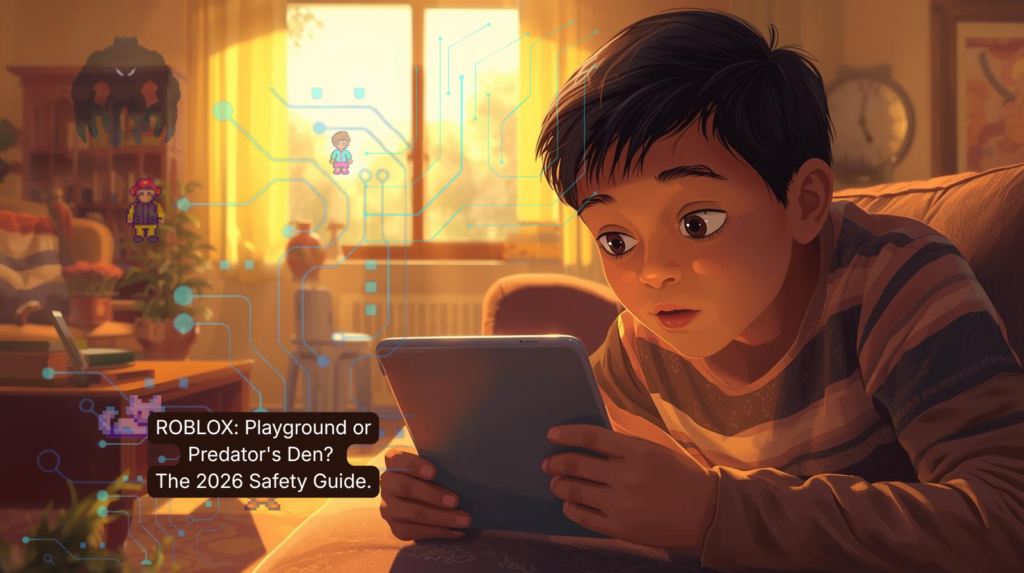
Is Roblox the new digital playground or a predator’s hunting ground? Here is everything you need to know to move from panic to partnership.
I used to think Roblox was just “online LEGOs.” I watched my daughter, playing Grow a Garden. It looked innocent enough—blocky characters, planting seeds, trading fruits. It felt like a digital lesson in the barter system.
Then, one evening, I glanced at her screen and froze.
A message from “CoolGamer_2015” popped up: “Hey Riya, want free Robux? Give me your mom’s phone number and I’ll send you the code.”
If this scenario sounds familiar—or terrifyingly possible—you are not alone.
With over 380 million monthly active users (40% of whom are under 13), Roblox is the defining digital experience of this generation. But while it offers creativity, it opens a door to risks every parent must manage.
This isn’t just a tech guide; it is your 2026 survival framework to keeping your child safe, sane, and emotionally resilient in the Metaverse.
Quick Summary
Is Roblox Safe? The Short Answer: Roblox contains user-generated content that can be risky for kids under 13. However, it can be made safe by:
- Setting correct Age Gating.
- Turning on “Account Restrictions.”
- Disabling Chat for strangers.
1. What is Roblox Really? (It’s Not Just a Game)
To protect your child, you must understand the beast. Roblox is not a single game like Mario or FIFA.
It is a YouTube for gaming. Just as anyone can upload a video to YouTube, anyone can create a “game” (called an Experience) on Roblox. This means your child isn’t playing a curated product; they are navigating a universe of millions of user-generated worlds.
The Core Mechanics:
- The Platform: A social hub where kids meet, chat, and jump between games.
- The Economy: “Robux” is the digital currency bought with real money. This creates a massive “Creator Economy” where developers (some kids themselves) compete for your child’s attention and wallet.
- The Social Network: It is a massive chatroom disguised as a video game.
2. Why Are Kids Obsessed? (The Psychology)
Why can’t they just put the mobile / iPad down? It’s not just “fun”—it’s engineered psychology.
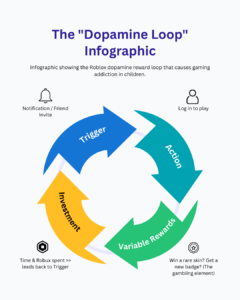
- Dopamine Loops: Variable rewards (like gambling) keep them coming back for “one more round.”
- FOMO (Fear Of Missing Out): Limited-time events and rare items create social pressure. “If I don’t get this skin, I’m a nobody.”
- Social Belonging: For 10-year-olds today, Roblox is the playground. Opting out can feel deeply isolating.
Research Note: Studies from the Oxford Internet Institute (2024) suggest that while “screen time” itself isn’t the enemy, the quantity and quality of interaction matters. Passive scrolling or negative social interactions are where the real harm lies, not just in the minutes spent playing.
3. The 5 Hidden Dangers Every Parent Must Know
Every parent should know following dangers associated with Roblox (click the link to read in detail).
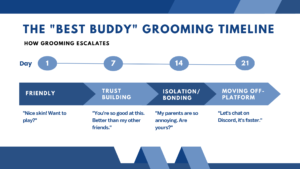
- The “Best Buddy” Effect (Grooming & Predatory Contact)
- The “Free Robux” Trap (Financial Scams)
- “Digital Playgrounds” & Cyberbullying
- Inappropriate Content and Explicit Games
- The Addiction Algorithm
Jump directly to How to Set Up Parental Controls on Roblox (Step-by-Step Guide)
Recent investigations have highlighted significant cracks in the platform’s safety. Here is what you need to know:
- The “Best Buddy” Effect (Grooming & Predatory Contact)
Imagine Riya meets Meera online who becomes her best buddy. They chat daily. Meera knows Riya’s school, her favourite color, and her dislike of math.
- The Reality: “Meera” could be a 40-year-old groomer using “trust-building” techniques.
- The Data: A bombshell report by Hindenburg Research (October 2024) flagged serious concerns about predator activity on the platform, noting instances where users could access inappropriate content despite filters.
Check Your Child’s Settings Now
-
The “Free Robux” Trap (Financial Scams)
The virtual economy creates real financial risks. Social pressure and digital identity demands (new avatar looks, skin) require Robux.
- Phishing: Sites promising free money in exchange for passwords or sensitive information.
- The Wallet Drain: McAfee’s “Connected Family” Report highlights that financial theft and gaming scams are top concerns for parents, with many discovering unauthorized charges only after the damage is done.
-
“Digital Playgrounds” & Cyberbullying
Bullying on Roblox targets a child’s avatar—their digital identity. Exclusion from games or “shaming” an avatar for looking “poor” (called a “bacon hair” in Roblox slang) is common.
-
Inappropriate Content and Explicit Games
- If the privacy settings are not set properly, young kids may be subject to inappropriate content and explicit games.
- Users sometimes upload games that simulate sex or violence. While Roblox moderation removes them, they can stay up long enough for thousands of kids to see them. The damage is done.
- The Addiction Algorithm
- It’s not just “distraction”—it’s design. The dopamine loops, FOMO are hard to ignore, specially for younger kids whose cognitive capabilites are still developing.
- Watchdog groups like Truth in Advertising (TINA.org) have filed complaints regarding “deceptive marketing” and “advergames” on Roblox—games that blur the line between entertainment and ads. These mechanisms are designed to maximize time-on-device, which Common Sense Media notes often leads to “time displacement”—eating into sleep and homework time.
Read more about screen addiction and science-backed strategies to reset the habits.
4. How to Set Up Parental Controls on Roblox (Step-by-Step Guide)
Do not ban Roblox. Manage it. Here is your immediate action plan.
Phase A: The Technical Shield (Do This NOW)
- Accurate Age Gating
Ensure the birth year on the account is correct for age-appropriate default settings to apply.
- Why? Roblox automatically applies strict filtering for users under 13. If the account age is set to be 13+, you disable these protections.
-
The “Privacy Settings” Lockdown
Enable parent PIN and lock down the Privacy Settings. Go to Settings -> Privacy:
- Contact Settings: Set “Who can message me?” to Friends Only (only if you personally know these friends) or No One (Recommended: No One For children under 9).
- Account Restrictions: Turn this ON. This limits play to a curated list of developer-verified, safe games.
-
The Financial Firewall
- Strict Rule: No credit cards saved on the device.
- Two-Factor Authentication (2FA): Enable this so no one can hack the account.
- Spend Caps. Disable or strictly cap in‑app purchases/Robux
The ‘Legal’ Binding
- Create a written Family agreement together.
- Co-create a family media plan with device zones, content, boundaries, safety rules and rewards/ consequences.
- Both sign and date it. Post it near the gaming device.
Download our Family Digital Agreement template for free.
(Don’t Argue. Agree. Download the exact Contract I use with my daughter.)
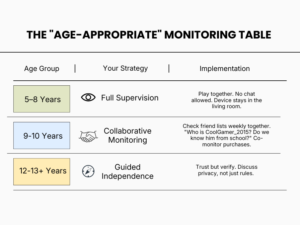
Phase B: From Surveillance to Coaching
Technical controls are the fence; you are the lifeguard.
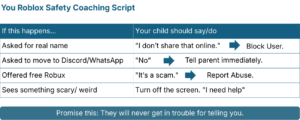
Phase C: The “Stop Phrases” Script
Teach your child exactly what to say/do. Print this out:
5. Healthier Alternatives to Roblox
No digital platform is perfectly safe, but some game types carry lower inherent risk because they are non‑chatty, non‑UGC, and non‑loot‑box-heavy.
If the risks feel too high, or you want to diversify their digital experience, try these safer bets:
- Minecraft (Creative Mode/Private Server): Focuses on building, less on social “hanging out” with strangers.
- Nintendo Switch Games (Mario/Zelda): These are “walled gardens”—complete, polished games with no user-generated surprises.
- Khan Academy Kids / Prodigy Math: Gamified learning that feels like an (Role-Playing Game) RPG but teaches actual skills.
6. The Missing Link: Emotional Intelligence (EQ)
Here is the harsh truth: You can set every parental control in the world, and a smart kid will eventually find a way around it.
The only permanent filter is your child’s brain.
Roblox is today’s challenge. Tomorrow it will be VR, AI companions, or the next big app. The solution isn’t chasing apps; it’s building Digital Resilience.
This requires specific EQ skills:
- Urge Control: The ability to close the laptop when the timer rings, even if they are winning.
- Critical Thinking: The ability to pause and ask, “Why is this stranger being so nice to me?”
- Self-Regulation: Managing the anger of losing a game without throwing a tantrum.
GrowUpWise specializes in exactly this. We don’t just teach safety; we teach the Emotional Intelligence required to navigate the modern world.
Does turning off Roblox cause a Level-10 Meltdown?
That isn’t bad behavior. That is a Dopamine Crash. Our Emotional Intelligence module teaches your child how to self-regulate when the screen goes black.
Enrol in the GrowUpWise Emotional Intelligence Module today. [Start Your Journey]

Frequently Asked Questions
Q: Is Roblox actually safe for a 7-year-old?
A: With “Account Restrictions” turned ON and chat disabled, yes. But it requires supervision. Treat it like a public park—you wouldn’t leave a 7-year-old there alone.
Q: My child screams when I turn it off. Is he addicted?
A: Likely not “addicted” in the clinical sense, but they are experiencing a dopamine crash. The game is designed to be hard to quit. This is a sign that they need help building Urge Control skills (a core pillar of our Emotional Intelligence course).
Q: Should I read my child’s messages?
A: Under 10: Yes, absolutely. Frame it as safety, not spying. “I check your messages like I check your seatbelt.”
Ages 10-12: Do it together. “Let’s look through your chats to see if anyone is being weird.”
Ages 13+: Spot checks based on trust.
Q: How do I talk to my child about online safety without scaring them?
A: This is perhaps the most important question—effective communication is your strongest protective tool.
- Frame it as “building skills” not “restricting freedom”.
- Keep conversations ongoing, not one-time lectures
For ages 5-8: “Just like we don’t talk to strangers in the park without Mummy or Papa there, we don’t chat with people we don’t know online. If someone we don’t know tries to message you, you come tell me right away—you won’t be in trouble, I just want to help keep you safe.”
For ages 9-11: “I want to talk about staying safe while gaming. Sometimes people online aren’t who they say they are—an adult might pretend to be a kid to try to become friends. If anyone asks you personal questions, offers you gifts, or makes you feel uncomfortable, that’s the moment to pause and talk to me. I trust you to make good choices, and I’m always here to help.”
For ages 12-13: “Let’s talk about online safety as you’re getting more independent. You’re smart and making good decisions, and I want to make sure you have all the information you need. Here’s what predatory behavior looks like online… Here’s why some people target kids on gaming platforms… What would you do if someone approached you this way?”
Final Thoughts: Partnership, Not Panic
Roblox isn’t “evil,” but it is a wilderness.
Your goal isn’t to be a prison warden. It is to be a partner. By combining the technical settings in this guide with the emotional skills taught at GrowUpWise, you aren’t just protecting your child from Roblox—you are preparing them for life.
Start today. The conversation you have tonight might be the one that keeps your child safe tomorrow.