Introduction: Why Raising Future-Ready Kids Matters More Than Ever
The world our kids are growing into looks nothing like the one we grew up in.
Getting a degree from a prestigious college was once a golden ticket to a successful career. Today, even the elite institutions are struggling with placements. The workforce landscape is changing at a fast pace. Jobs that exist today may not exist tomorrow! AI, automation, global shifts, and social transformations are reshaping what it means to thrive in life—not just in careers. The pace of the change is terrifying!
As parents, we want our kids to succeed. But success is no longer just about grades, test scores, or technical skills. Instead, it’s about resilience, emotional intelligence, adaptability, problem-solving, and a growth mindset—the life skills that research shows are essential for long-term success and wellbeing.
The challenge? These skills aren’t always taught in schools. Which means the responsibility falls on parents and caregivers to nurture them at home.
This guide is your evidence-based, science-backed roadmap to raising future-ready kids. You’ll discover:
- The 7 core life skills every child needs for tomorrow.
- Insights from neuroscience and child psychology that explain why they matter.
- A step-by-step Implementation Roadmap with practical activities for parents.
- A free downloadable worksheet so that you can start today
Let’s dive in.
In this guide, we cover:
Click any skill to jump to that section.
The Science Behind Future-Readiness: What Research Tells Us
Before we get into the “how,” let’s ground ourselves in the “why.”
- The Brain’s Plasticity
Neuroscience confirms that children’s brains are highly plastic between ages 5–12. The prefrontal cortex—responsible for decision-making, self-regulation, and problem-solving—is still developing (Center on the Developing Child, Harvard University). This makes childhood the prime window to build lifelong habits and skills.
- Emotional Regulation Predicts Future Success
A landmark longitudinal study (Moffitt et al., 2011) tracked 1,000 children over 30 years and found that children with higher self-control grew into healthier, wealthier, and happier adults. It concluded that a child’s ability to self-regulate is a stronger predictor of adult success than their IQ or socioeconomic background.
- Growth Mindset Boosts Achievement
Carol Dweck’s research shows that children who believe their abilities can grow through effort (growth mindset) perform better academically, show more resilience, and are more likely to take on challenges.
- Social-Emotional Skills and Academic Success
The Collaborative for Academic, Social, and Emotional Learning (CASEL) finds that social-emotional learning (SEL) increases academic performance by 11 percentile points. SEL encompasses self-awareness, self-management, social awareness, relationship skills, and responsible decision-making.
Life skills and academic learning aren’t separate—they reinforce each other.
Key Takeaway: Future readiness is not an extra. It’s a scientifically proven foundation for lifelong success and wellbeing.”
The 7 Core Life Skills for Future-Ready Kids
These are the building blocks every child needs:
- Emotional Regulation – Managing feelings, learning calm-down strategies, resilience, and empathy.
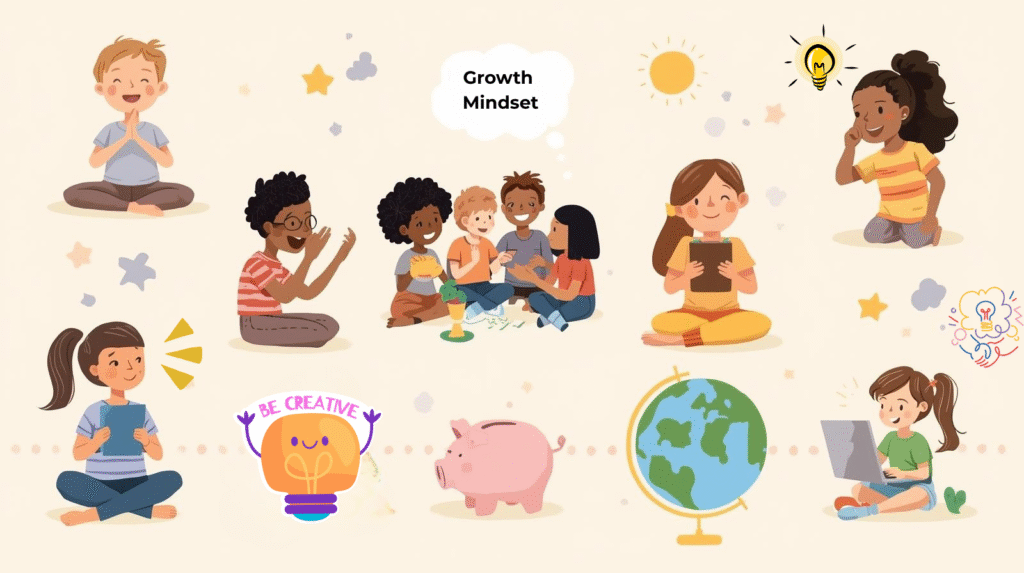
- Growth Mindset – Embracing challenges and learning from failures.
- Communication Skills – Active listening, conflict resolution, storytelling.
- Critical Thinking – Asking good questions, problem-solving, and analytical capabilities.
- Financial Literacy – Understanding money, saving, and smart spending.
- Digital Safety & Balance – Protecting online identity, managing screen time, navigating technology wisely and setting boundaries.
- Adaptability & Curiosity– Staying flexible and open to change.
Feeling overwhelmed by all 7 skills? You don’t have to memorize them.
👉 Download the One-Page Cheat Sheet: The Future-Ready Skills Tracker
Each of these can be nurtured through simple, practical parenting strategies. That’s where the roadmap comes in.
Implementation Roadmap: How Parents Can Raise Future-Ready Kids
This is the actionable heart of the guide. Below is a step-by-step roadmap, with ready-to-use examples for each skill area.
Each skill development area includes:
- Why it matters (what’s at stake).
- Scientific Insight (why it works).
- How to implement (science backed strategies that work).
- Example Activity (ready-to-use at home).
- Build Emotional Regulation
- Why it matters: Kids who can manage emotions recover faster from setbacks and form healthier relationships.
- Science says: Co-regulation (parent + child managing emotions together) strengthens the child’s neural pathways for self-regulation (Siegel, The Whole-Brain Child).
How to implement:
- Create a “Calm Corner” at home with stress balls, colouring books, or breathing prompts. When your child feels upset, they can go to the “Calm-Down Corner” and choose a tool to calm down before reacting.
- Use “Name it to Tame it”—help your child identify and label emotions (“I feel frustrated”) to reduce intensity.
- Role-model calm responses when stressed.
Example activity:
- “Traffic Light Technique” → Red = Pause, Yellow = Breathe, Green = Act. Kids can draw their own traffic light poster.
2: Cultivate a Growth Mindset
- Why it matters: Kids with growth mindset are more persistent, enterprising and less afraid of failure.
- Science says: Carol Dweck’s research shows mindset language rewires how children see effort vs. talent, shifting their focus from innate ability to the value of dedication and hard work. Praising talent in children can foster a “fixed mindset,” On the other hand, praising effort and process, fosters “growth mindset,”
How to implement:
- Praise effort, not outcome. (“I love how hard you worked on this puzzle!”)
- Normalize mistakes by sharing your own and framing them as learning opportunities.
- Use the word “yet” with challenges. When your child says, “I can’t do fractions,” Use growth-oriented language to reply: “You can’t do fractions yet. Let me help you where you are getting stuck.”
Example activity:
- Create a “Growth Journal” where your child writes down things they can’t do yet and tracks progress.
3: Strengthen Communication Skills
- Why it matters: Effective communication is the foundation of teamwork, leadership, and relationships.
- Science says: Children’s early language exposure impacts their later linguistic skills, cognitive abilities, and academic achievement (NIH).
How to implement:
- Use family meals as “tech-free conversation zones.” Discuss any topic that interests your child. Encourage their participation.
- Play “Feelings Charades” where kids guess emotions through expressions.
- Encourage storytelling—ask open-ended questions (“What was the funniest part of your day?”).
Example activity:
- Play “Two Truths and a Dream” → Share two true things and one dream, and let others guess. Builds expression and listening skills.
4: Kindle Critical Thinking
- Why it matters: Future jobs will require innovation, problem-solving and adaptability.
- Science says: Play-based problem-solving boosts executive function and creativity (Barker et al., 2014). Open-ended questioning activates the brain’s prefrontal circuits for reasoning and flexibility (Diamond, 2013).
How to implement:
- Ask guiding or probing questions instead of giving solutions. (“What’s another way we could try this?”)
- Encourage board games like chess or strategy puzzles.
- Play “What Else Could It Be?” with everyday objects. (Example: Spoon “Besides eating, what else could this be?” drumstick, tiny shovel, catapult)
Example activity:
- “Design a Superhero Tool” → Give kids random items (string, cup, cardboard) and ask them to invent a tool.
5: Introduce Financial Literacy
- Why it matters: Early money habits stick for life.
- Science says: Children start forming financial attitudes by age 7 (Cambridge University study, 2013).
How to implement:
- Give small allowances and teach budgeting (Spend, Save, Share jars). (Read more on why 6-year-olds need money lessons here.
- Talk openly about household decisions (why you compare prices, why saving matters, various investment strategies).
- Use personal stories and games to explain concepts like interest and inflation.
Example activity:
- “Savings Challenge” → Kids set a goal (toy, book) and track progress weekly.
6: Teach Digital Safety & Balance
- Why it matters: Indian children’s screen time is very high, children under five averaging 2.2 hours daily (double the recommended safe limit) and adolescents exceeding 4-5 hours daily. Safe, balanced use is essential.
- Science says: Excessive screen time impacts attention and sleep; guided use builds digital literacy (APA, 2019).
How to implement:
- Create a Family Tech Agreement with rules everyone follows. (See our full guide on Digital Safety for Indian Kids)
- Teach “Pause-Think-Post” before sharing online.
- Balance screen time with outdoor play and offline hobbies.
Example activity:
- “Digital Detox Jar” → Add fun offline activities to a jar; kids pick one during screen-free time.
7: Nurture Adaptability & Curiosity
- Why it matters: The only constant is change. Curious, adaptable kids thrive in uncertainty.
- Science says: Curiosity lights up the brain’s reward system, boosting learning and retention (Gruber et al., 2014).
How to implement:
- Celebrate questions, not just answers. (“That’s an interesting question! Let’s explore it together.”)
- Rotate books, activities, or toys to spark novelty.
- Involve kids in planning family events or solving small household challenges.
Example activity:
- “Curiosity Box” → Place mystery items (shell, old photo, tool) in a box and explore them together.
Track their growth, week by week. Get the free Future-Ready Skills Tracker.
To make this roadmap actionable, we’ve created a free downloadable worksheet on ✅ Skill Tracker – Track weekly progress on emotional regulation, communication, problem-solving, and other life skills.
FAQs: Raising Future-Ready Kids
Q1: What age should I start teaching life skills?
Start as early as 5. Even concepts like saving money, labelling emotions, or asking curious questions can be introduced in age-appropriate ways.
Q2: How much time should I spend on these activities daily?
10–15 minutes of focused, intentional practice is enough. The goal is consistency, not length.
Q3: My child resists. How do I encourage them?
Make it fun and collaborative. Use games, stories, or family challenges instead of lectures.
Q4: What if I don’t have time as a busy parent?
Integrate skill-building into daily routines—mealtime, bedtime, grocery shopping, or car rides.
Q5: Are these strategies culturally adaptable?
Yes. The roadmap uses universal principles of neuroscience and psychology but allows flexibility for cultural values, family routines, and traditions.
Q6. How do I balance academics with these skills?
Use smart ways to integrate such practices into day-to-day activities. For example, use homework mistakes as growth mindset opportunities. Shift to open ended questions.
Q7. Do I need special training to teach my child?
No. Simple daily practices—like dinner table questions—are enough.
Conclusion: Planting Seeds for Tomorrow
Raising future-ready kids doesn’t require perfection or massive time investments. It requires consistent, small steps, grounded in science and infused with love.
Every time you help your child pause before reacting, encourage them to try again, or celebrate their curiosity, you’re wiring their brain for resilience, adaptability, and lifelong success.
The world may be uncertain, but one thing is clear: by building these skills today, you are gifting your child the confidence and tools to thrive tomorrow.
👉 Track Their Growth, Week by Week. Download the free Future-Ready Skills Tracker worksheet.
Don’t just hope they are learning—see it happen. Get the free Future-Ready Skills Tracker to measure their progress in confidence, resilience, and emotional intelligence.
To make this roadmap actionable, we’ve created a free downloadable worksheet on:
✅ Skill Tracker – Track weekly progress on emotional regulation, communication, problem-solving, etc.