Introduction: A Parent’s Worry in the Age of Screens
It was a bustling Sunday morning as we had guests coming over. When I walked into my kid’s, I found my 9-year-old daughter glued to my tablet. The screen flickered with a fast-paced YouTube video—bright colors, catchy music, but also, a disturbing imagery with a link leading her to a potentially dangerous website.
My heart sank.
I had given her the tablet for a short cartoon break, but in just ten minutes, she had wandered into a digital alley she never meant to enter.
Sounds familiar?
If you’re a parent in India today, you’re not alone. Many parents are worried about online Safety for Kids in India.
Children between 5–12 years spend an average of 3–4 hours a day online (Nielsen India Report, 2023). From YouTube shorts to online gaming to classes on Zoom, the internet is no longer an extra—it’s the necessary evil that needs to be tamed.
The digital powerhouse that opens doors to knowledge also expose children to risks—cyberbullying, screen addiction, unsafe and inappropriate content, privacy violation and predatory strangers!
This is the reality of digital danger.
And as parents raising future-ready kids, our challenge is not just to protect them but to prepare them—with habits, skills, and resilience that will keep them safe, balanced, and thriving.
This post is your science-backed, culturally-rooted roadmap for digital parenting, to keeping children safe online while nurturing lifelong digital wisdom.
In a hurry? Don’t leave without protection. 👉 Skip to the end and download the Family Digital Safety Toolkit
What you will learn:
(click on the link to navigate to the section)
The Digital Childhood in India: What’s Really Happening?
- The Numbers We Can’t Ignore
- 70% of Indian children aged 8–12 have experienced at least one cyber risk such as bullying, inappropriate content, or data misuse (McAfee India Report, 2022).
- 1 in 3 internet users in India is under 18 (UNICEF, 2019).
- The average age for a child’s first smartphone is now 10 years in Indian metros (IAMAI Report, 2023).
- Why Kids Are More Vulnerable
Children’s brains are still developing. The prefrontal cortex—the area responsible for impulse control and decision-making—doesn’t fully mature until the mid-20s (Casey, 2015, Nature Reviews Neuroscience).
This means kids are biologically more prone to:
- Clicking impulsively.
- Believing strangers online.
- Getting hooked on addictive algorithms.
Key Insight: Kids aren’t just “mini-adults.” They process risk differently, and hence parental guidance and skill-building support is a must to help them in navigating it safely.
Behind the Screen: The Hidden Dangers Parents Must Know
Internet and social media are going nowhere! Online spaces are lurking with dangers that we should understand to keep our kids protected online. Let’s delve into these.
-
Screen Addiction
“Just five more minutes, Mumma!”
If you’ve heard this (or said it yourself while scrolling), you understand the pull. But for children aged 5-12, whose brains are at peak neuroplasticity, the impact runs deeper than a bad habit.
- Apps and games are designed like slot machines, rewarding kids with likes, coins, and points (Alter, 2017, Irresistible).
- Behind the apps and games, we check every day, there’s a whole world of research and design aimed at making them as engaging—and addictive—as possible.
- Excessive screen time can disrupt sleep, reduce attention span, and even lead to emotional dysregulation and behavioural issues in kids.
-
Cyberbullying
- Over 36% of Indian children reported being bullied online (Microsoft Global Online Safety Survey, 2021). The impact is not just emotional but neurological—chronic stress alters brain circuits tied to self-esteem and resilience.
- Students in the cyberbullying victims/bullies’ group had the worst scores for psychological and physical health and academic performance; associated with depression and anxiety.
-
Exposure to Unsafe Content
- Unfiltered access leads to early exposure to violence, pornography, and harmful ideologies.
- Research shows that such early exposure may lead to poor mental health, aggressive behaviour and rewire reward pathways in the brain, leading to desensitization (Owens et al., 2012).
- It’s not just YouTube. Consider:
-
- Gaming chat rooms: Where adult strangers or predators can communicate with your child in real-time and influence them perilously
- TikTok and Instagram Reels: Where children as young as 7 are exposed to body image pressure, dangerous challenges, and premature sexualization
- WhatsApp groups: Where offensive jokes, misinformation, and inappropriate content spread through class groups
-
Digital Strangers & Predators
- Children often cannot differentiate between safe and unsafe online friendships.
- Grooming tactics—slow trust-building by predators—are rising in India (NCRB, 2022).
- Online grooming is a sophisticated form of manipulation where predators deliberately build relationships with children online to leverage their vulnerabilities and prepare them for sexual exploitation or even sex trafficking initiation.
-
Data Privacy & Exploitation
- Children unknowingly share data via games and apps that can be used by online predators to create their profiles or identify vulnerable targets for exploitation.
- A 2022 UNICEF report found that most Indian parents underestimate how much personal information their kids’ apps collect.
- PwC India survey (2024) reveals that only 16% consumers in India understand the Digital Personal Data Protection (DPDP) Act. 56% of consumers are not aware of their rights related to personal data and 69% of consumers are not aware of their rights to take back their consent. Whenever a minor’s personal data is involved, 72% of respondents are not aware that handling a minor’s personal data requires a parent/guardian consent.
Here’s Free Digital Safety Toolkit (Downloadable) for you to take the first step today to ensure Online Safety for Kids in India
What’s inside this free Digital Safety Toolkit for Indian Parents (ages 5–12).
- Family Digital Agreement Template (ready to print & sign).
- Screen Time Tracker (visual progress)
- Digital Safety Rules Poster (print-ready)
Why Bans Fail: Building Digital Wisdom, Not Just Digital Walls
The “just ban screens” approach fails for three reasons:
- Digital literacy is non-negotiable for future success: By 2030, jobs success will require digital skills (World Economic Forum). Completely restricting access handicaps your child’s future.
- Forbidden fruit is sweeter: Children with total bans are more likely to engage in risky online behavior when they do get access, because they haven’t developed self-regulation skills.
- It damages trust: Extreme restrictions signal that you don’t trust your child, making them less likely to come to you when they encounter danger.
So, what does work?
Neuroscience shows that habit loops formed in childhood last into adulthood (Lally et al., 2010). Which means the digital habits you help your child form today will define their future relationship with technology.
|
The goal is not to ban screens but to train digital wisdom.
The Parent’s Roadmap to Online Safety for Kids in India
(Science-Backed & Practical)
Here’s a step-by-step implementation guide you can start today.
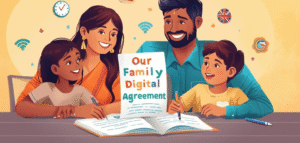
Step 1: Create a Family Digital Agreement
- What it is: A written pact with rules for screen use.
- Why it works: Kids are more likely to follow rules they help create. Research on “autonomy-supportive parenting” (where parents intentionally involve their kids in making decisions and performing actions, in age-appropriate and safe ways) shows this increases compliance (Deci & Ryan, 2000).
- How to do it in India: Print a simple poster with rules like “No phones at mealtime,” “Screen-free bedtime,” and sign it as a family.
Step 2: Balance Screen Time with Real Play
- Science says: Play-based learning is recognized as a pivotal approach in early childhood education, fostering cognitive development through exploration, imagination, and social interaction.
- Action idea: Introduce a “Digital Detox Jar”—fill it with chits like kite-flying, favourite sports, rangoli drawing, craft making, dance party. Kids pick one when it’s time to unplug.
Create Age-Appropriate Boundaries for screen time. Check this post on details “Too Much Screen Time? Science-Backed Ways to Reset Your Child’s Habits (Without Tears or Fights)”.

Step 3: Teach Pause–Think–Post
- Why: A simple pause before clicking reduces impulsive behavior.
- Science: Excessive screen time impacts attention and sleep; guided use builds digital literacy (APA, 2019). The mindful pause activates the prefrontal cortex, giving the brain time to respond thoughtfully rather than impulsively.
- Activity: Create a traffic light poster → Red (Pause), Yellow (Think), Green (Post/Click safely). Include ‘Think’ prompts like “Will I love this post after 2 days?”, “Is this giving away too much information?”,” Would it be okay if everyone saw this?”
Step 4: Role-Model Digital Behavior
- Why: Kids imitate what they see. Through observational learning, they imitate both positive and negative behaviours
- Science: Mirror neurons make children copy parent behaviours unconsciously (Marco Iacoboni).
- Tip: Keep your own phone away during meals or family time. Kids notice.
Step 5: Keep Communication Open
- Why: Regular, judgement-free check-ins give kids confidence to open up with parents without being scared of reprimand or confiscation of screens. Children who talk openly with parents are less likely to hide online risks or creepy stuff.
- Science: Warm, responsive parenting builds trust circuits in the brain (Siegel, 2012).
- Action: Create a bedtime ritual where kids can share “one good, one tricky” thing they saw online that day. Show genuine interest in what they watch.

Create judgment-free zones: If your child encounters something disturbing, your first response determines whether they’ll trust you with future concerns. Avoid: “I told you not to click random things!” Instead: “That sounds scary. I’m so glad you told me. Let’s figure out what happened together.”
Step 6: Strategic Supervision (Smart Monitoring without being overprotective or controlling)
Our kids need support and guidance for navigating online space safely.
Use technology wisely for supervising your kid’s online activities.
- Enable parental controls on devices, routers, and apps
- Use monitoring apps transparently (tell your child what you’re monitoring and why)
- Check privacy settings quarterly (they update constantly)
- Be aware of “finsta” accounts (fake Instagram accounts kids create to avoid parent monitoring)
Transparency is non-negotiable: Never use secret monitoring (spyware on phones, hidden cameras). It destroys trust and models the exact behavior you’re trying to prevent—deception.
Random checks with guidance: Instead of daily surveillance, do periodic reviews together. Once a week, sit with your child and go through:
- Their followed accounts
- Recent search history
- Friend requests they received
- Any messages that felt “weird”
- Games they are playing online
Frame it as partnership: “I’m helping you practice safe decisions until your brain is ready to do it automatically.”
Technical essentials for Indian parents to ensure kid’s digital safety:
- Set up Google Family Link or Apple Screen Time with appropriate age restrictions
- Disable in-app purchases (or require password approval)
- Turn off location services for social apps
- Use YouTube Kids instead of regular YouTube for children under 12
- Check app permissions regularly (A drawing app needing microphone or location access should raise concerns)
Step 7: Build Life Skills Alongside Digital Safety
This is where most parents miss the bigger picture. Online safety isn’t just about filters and passwords—it’s about building resilience, critical thinking, and emotional regulation.
- Teach emotional regulation so they don’t spiral after cyberbullying. (See our guide on managing meltdowns and emotional storms here)
- Build a growth mindset and resilience so they bounce back from online failures.
- Strengthen critical thinking so they can spot fake news or unsafe strangers.
In short → Digital safety is life skills in action.
A Glimpse into the Digital Safety Toolkit (Free Download) for Online Safety for Kids in India
To make this easy, we’ve designed a free Digital Safety Toolkit for Indian Parents (ages 5–12).
What’s inside:
- Family Digital Agreement Template (ready to print & sign).
- Screen Time Tracker (visual progress)
- Digital Safety Rules Poster (print-ready)
FAQs on Digital Safety for Kids in India
Q1: At what age should my child get a phone?
There’s no universal age, but research recommends delaying personal smartphones until at least age 13 (AAP). Before that, if needed, use a family-shared device with parental controls and strict boundaries.
Q2: Should I use parental control apps?
Yes, but as training and supervision support. Use them while also teaching self-regulation.
Q3: My child already spends 5+ hours online. Is it too late?
No. Start small—introduce tech-free meals, a digital detox day, and model balance yourself. Habits can be reshaped.
Q4: What is the biggest digital danger for kids today?
The top risks include cyberbullying, online predators, inappropriate content, excessive screen time, and digital addiction. Research shows Indian children spend higher time online daily than the recommended screen time, increasing exposure to risks if not guided.
Q5: How do I talk to my child about online safety without scaring them?
Use open, age-appropriate conversations. Instead of warnings like “Don’t talk to strangers online,” say: “Some people online may pretend to be kids but aren’t. If anyone makes you uncomfortable, come to me — you won’t get in trouble.”
This builds trust, not fear.
Q6: What apps are unsafe for kids in India?
Be cautious with apps that allow anonymous messaging, live streaming, or easy stranger access. Always check app ratings (PEGI/Google Play age ratings) and reviews before approving.
Q7. How can I monitor my child’s online activity without breaking trust?
Shift from spying to guiding:
- Use parental control apps transparently (“We’ll use this to stay safe, not to punish”).
- Place devices in common areas.
- Do weekly “digital check-ins” where kids share what they’re enjoying online.
Q8. What are signs my child is being cyberbullied?
Warning signs: sudden withdrawal, anxiety about devices, deleting accounts secretly, or falling grades. Research in India shows 1 in 3 children have faced online bullying (Internet and Mobile Association of India, 2022).
Q9. How do I protect my child from online scams?
Teach the Golden Rule: Never share OTPs, bank details, or passwords — not even with friends. Explain phishing tricks (“Click to win” or “free recharge” offers). Set up alerts for online purchases.
Q10. Is YouTube safe for kids?
YouTube can be unsafe due to autoplay and ads. Use YouTube Kids, turn off autoplay, and co-watch content. Create a playlist of trusted channels instead of letting kids browse freely.
Q11. What is a Family Digital Agreement?
It’s a written pact where parents and kids co-create rules for screen time, safe browsing, and device use. Having kids help design it increases compliance. This is a proven behavioural strategy from habit-building psychology (BJ Fogg, Stanford Behavior Design Lab).
Q12. What’s the first step I should take today to improve my child’s online safety?
Start with one small step:
- Turn off location sharing
- Set a family No-screen rule
- Set up parental control
Tiny steps add up — consistency is more important than perfection.
Conclusion: Preparing, Not Preventing
Digital safety isn’t about preventing your child from engaging with technology. It’s about equipping them to engage wisely.
The digital world isn’t going anywhere. But with the right knowledge, tools, and support, your child can explore it safely, confidently, and wisely.
Your child’s digital safety starts with you. Will you take the first step today?
👉 Download the Digital Safety Toolkit today and take your first step toward raising a future-ready, digitally wise child.