It’s 4 pm. Ananya has been watching TV since she came back from school. I remind her to turn it off. She promises me “5 more minutes.” Hours later, I peek through the home camera—she’s still glued to the screen. My temper shoots, I scold, and moments later I get a message: “Mumma, I hate you!”
If you’ve ever been called the ‘meanest parent ever’ just for switching off the TV, you’re not alone.
For many parents, screen time has become a daily battlefield. But here’s the truth: it’s not just your child being “stubborn.” It’s biology, design, and context at play. Let’s unpack this—and learn practical, science-backed ways to reset screen time habits without tears and tantrums.
Why Do Kids Crave Screen Time?
Screens are designed to be addictive. Bright colors, auto-play, and endless feeds create dopamine surges in the brain—the same system that makes adults binge-watch Netflix until midnight.
For kids, it’s harder:
- Developing brains: Their impulse control isn’t fully wired yet.
- Boredom triggers: Older kids turn to social media when bored or under peer pressure.
- Parent habits: Many of us introduced screens early—feeding toddlers while playing cartoons or using them as a “babysitter.”
Traditional joint family structures provided natural entertainment and engagement through stories, games, and multi-generational interactions. Today’s nuclear families, especially in urban areas, often rely on screens to fill this engagement gap.
Busy working parents amplify this challenge. Sometimes we choose screens when we’re tired or unsure how to engage meaningfully.
Many of us, myself included, have relied on screens as a quick fix for fussy meals or tired evenings. The key is not guilt—but small, intentional resets.
What Counts as “Too Much”?
According to the American Academy of Paediatrics (AAP):
- Under 18 months: No screen time (except video calls).
- 18–24 months: Only high-quality media, with parent guidance.
- Ages 2–5: Max 1 hour/day, co-viewed.
- Ages 6+: Max 2 hours/day (excluding homework).
This can be a guide to screen time rules for kids in India.
The Hidden Costs of Excessive Screen Time
Research and studies by NIH establish:
- Exposure to more than four hours/day of screen time was associated with higher symptoms of depression, anxiety, and stress.
- Children spending >2 hrs/day score lower on language and thinking tests.
- Children spending >7 hrs/day show thinning of brain cortex.
Some long-term consequences of excessive screen time include:
- Sleep problems: Difficulty falling asleep or getting restful sleep.
- Mood swings: Increased irritability or anxiety.
- Social withdrawal:Spending less time with family and friends.
- Loss of interest: Neglecting hobbies or activities previously enjoyed.
- Physical complaints: Frequent headaches, eye strain, or neck and shoulder pain.
- Reduced attention span: Difficulty concentrating on tasks.
Feeling overwhelmed? You don’t have to fix this alone. 👉 Jump to the end and get the Screen Time Reset Kit
Resetting Screen Habits: Science-Backed Strategies
We will explore some science-backed parenting hacks for screen addiction, and reduce kids screen time without fights.
Here are doable shifts that actually work:
✅ Set clear daily limits – Keep them consistent. Kids thrive on routine.
✅ Give choice within boundaries – Let them pick content/time slot.
✅ Start small – Reduce by 15 mins each week instead of a sudden ban.
✅ Offer healthy swaps – Outdoor play, hobbies, family projects.
✅ Co-play & co-watch – Be fully present. Put your phone away.
✅ Celebrate wins – Track progress, reward milestones.
✅ Define no-screen zones – Mealtime, bedtime, mornings.
✅ Model habits yourself – If you scroll all evening, kids will too.
Practical Implementation Guide
- Assessment: Before changing behavior, we need baseline data. Assess current usage: Note patterns, content, peak times.
- Track Current Usage: Use built-in screen time reports (iOS Screen Time, Android Digital Wellbeing) to measure actual usage vs. perceived usage
- Review Content: Document what your child watches/plays during peak usage times
- Identify Trigger: Note emotional states that trigger screen requests (boredom, frustration, transitions). I realized my daughter’s screen time peaked when I was working from home and on days with no classes, and this helped in planning her screen time and other activities.
- Create a screen plan together:
- Let kids co-design rules & schedules.
- Help them prioritize urgent and important tasks like homework, exam preparation, project submission, outdoor play.
- Decorate the Screen Plan and place it strategically for visual reminder.
- Use smart swaps:
- Substitute mindless online content with age-appropriate educational programs (like “Sesame Street”, “PBS Kids”, Art for Kids Hub, TED-Ed shows can teach children facts, healthy behaviours, and emotion management when used strategically).
- Replace binge TV with enriching shows, reading, or creative activities.
- Visible Alternatives: Art supplies, books, puzzles in easily accessible locations
- Introduce transition rituals: Instead of abrupt cutoffs, use transition warnings that help children emotionally prepare. e.g., 10-min music dance party before shutting off the screen.
- Set up screen-free zones and Zero-Tolerance No Screen Policy
- Set up screen-free zones – Dining table, Bedroom, Study Spaces.
- Zero-Tolerance No Screen Policy
- Meal/Play Times: No Background TV during meals/play
- Mindful Watching: No YouTube scrolling without specific purpose
- Bedtime Routine: No Screens within 1 hour of bedtime
- Morning Routines: No screens until after breakfast and getting dressed
- The “Boredom Buster” Jar: Screens are the quick fix when a child is bored. To break the habit, you need an accessible alternative. Create a jar filled with “chits” featuring your child’s favorite offline activities (craft kits, board games, instrument play). The next time they look for a screen to fill the void, have them pull a chit instead. It removes the struggle of “finding something to do” and makes unplugging feel like a game of chance.
- Weekly joint project: Identify one activity that your family loves and look forwards to during the weekend. It can be anything from Family cooking, crafts, gardening—something that vibes with your family. Prepare in advance.
Implementation of this strategy when coupled with emotional regulation can lead to high impact solutions. You can check this post on understanding and managing emotional meltdowns to get you started on supporting your kid to develop emotional regulation.
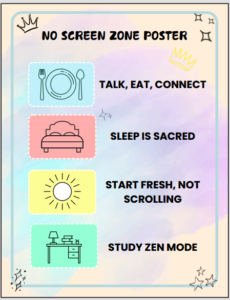
Print this poster and stick it on the dining table today.
Conversation Starters with Kids
Instead of commands (“Switch it off now!”), try questions:
- “What’s one fun thing we can do together instead?”
- “How does your body feel after too much screen time?”
- “Want to plan a no-screen challenge this weekend?”
Pro Tip: Use Tools Wisely
Parental controls are great—but don’t rely on them alone. Quality matters as much as quantity. Shift from endless passive watching to active, meaningful digital experiences.
Final Word: Big Change Starts Small
Resetting screen time isn’t about punishment—it’s about building self-control and healthy alternatives. When kids feel empowered, and parents model balance, screen habits reset naturally.
📩 Want a Printable Screen Time Reset Kit?
Get our free, research-backed toolkit with:
- A Weekly Media Planner (co-create with your child!)
- No-Screen Zone Posters for your home
- A fun Reward Tracker to celebrate milestones
After two weeks of using our screen plan, Ananya now shuts down the TV herself at 6:30 pm because she’s excited about our family game.
🔑 Key Takeaway for Parents
Screens aren’t the enemy—uncontrolled use is. With clear boundaries, engaging alternatives, and family consistency, you can raise a screen-smart child without daily battles.
Know another parent fighting the screen-time battle? Share this post with them.